
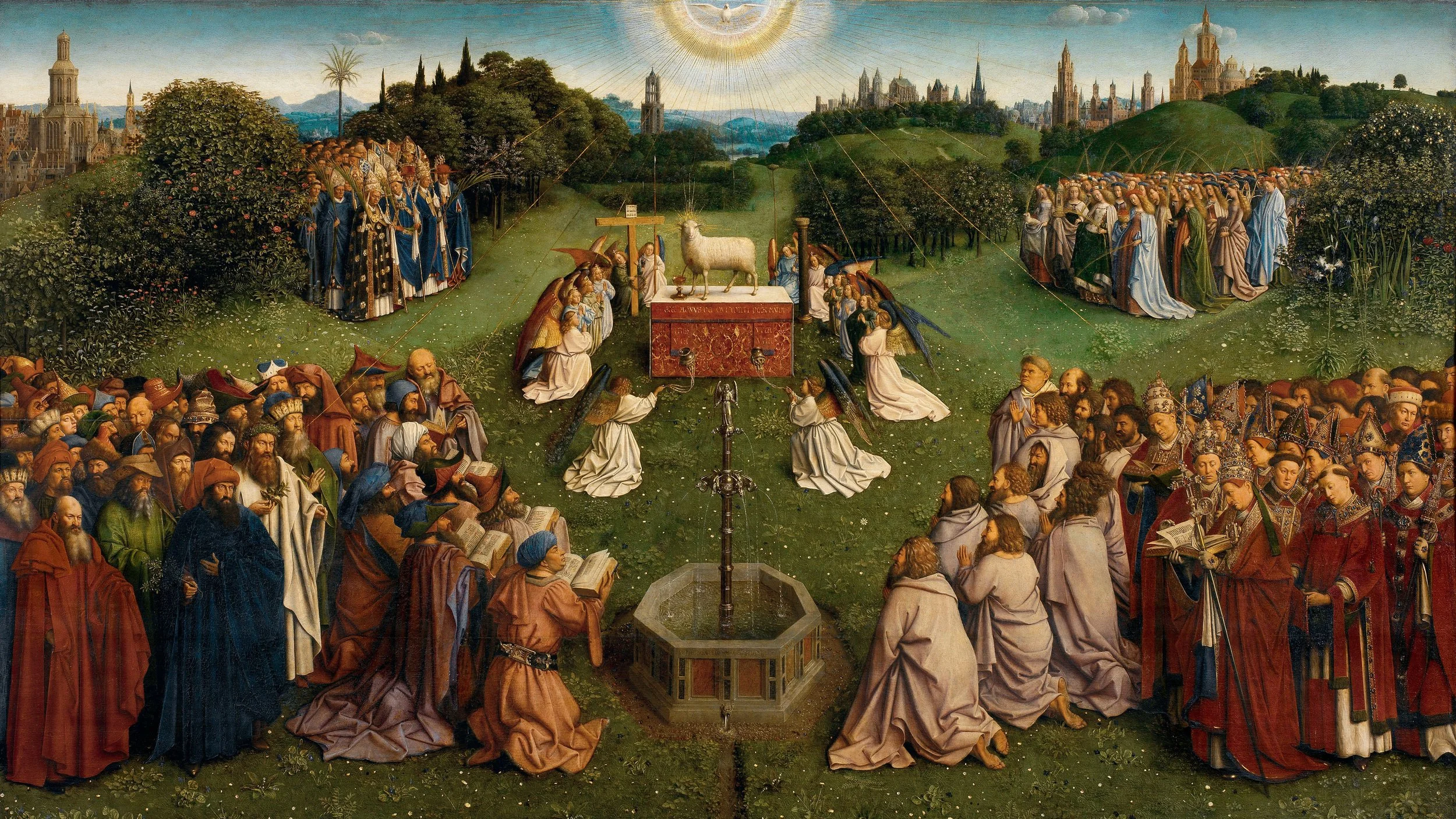
Hubert and Jan van Eyck, Adoration of the Mystic Lamb, 1426–32. Lower central interior panel of the Ghent Altarpiece, St. Bavo Cathedral, Ghent, Belgium.
I’ve never heard a Lenten, or Easter, sermon preached from the book of Revelation.[1] However, I think it’s an excellent text for both.
Revelation is full of mind-bending imagery. These images are intended to shock us; to awaken us from our spiritual stupors; to make bold theological, Christological, and ecclesial claims. They’re meant to reveal.
One of these provocative images is the “Lamb standing as if it had been slaughtered” (Rev 5:6, NRSV).[2]
Our English renderings of this verse often minimize the significance conveyed in the Greek. The “as if” introduces uncertainty—the Lamb only appears to have been slain. However, there’s no such uncertainty in the Greek. John, Revelation’s author, uses the Greek perfect tense (the tense used for completed past actions which have present, ongoing implications) for both “standing” (εστηκος) and “slaughtered” (εσφαγμενον). John is communicating that Jesus died (completed past action) and resurrected (completed past action) and that both realities have present, ongoing significance.
It’s the image’s simultaneity—that Jesus is dead and alive, that he bears his crucifixion wounds in his resurrected state—that is so mind-bending. John fuses together what we often tease apart. The image undoubtedly depicts Jesus’ resurrection. It shows that he overcame death when God raised him from the dead. He is alive and victorious! However, it also reveals that Jesus’ wounds are permanent features of his glorified existence. The resurrection doesn’t eclipse the cross. For John, the risen Jesus is still, and always will be, the crucified Jesus.
John’s portrayal of the standing-slaughtered Lamb speaks to the very nature of who Jesus is. It speaks to the way Jesus died, the way he lived, and his current heavenly reign. Reading a bit further in Revelation 5, we get a glimpse of what this looks like.
'You are worthy to take the scroll and to open its seals, for you were slaughtered and by your blood you ransomed for God saints from every tribe and language and people and nation’ (Rev 5.9).
‘Worthy is the Lamb that was slaughtered to receive power and wealth and wisdom and might
and honor and glory and blessing!’ (Rev 5.12).
The four living creatures and elders praise Jesus’ sacrifice. They worship his victory through slaughter. Surprisingly, it’s Jesus’ death, not his resurrection, that is being celebrated as the victorious act in this hymn of praise. According to G.K. Beale, this worship scene makes clear that “Christ’s overcoming began even before the resurrection.”[3] Beale notes that this is a deliberate move on John’s part. The language of conquering/overcoming/victory, and its connection to faithful witness, is pervasive in Revelation. John intentionally redefines what victory and overcoming look like to help the churches reorient how they understand their present shortcomings, temptations, and hardships. For John, faithful witness = victory; faithful witness even to death = conquering; the way of the Lamb = overcoming.
To clarify, John is not advocating martyrdom. But he is advocating for a massive paradigm shift—that the churches radically redefine their understanding of victory. Victory is not measured by political influence, military might, personal wealth, societal standing, or self-preservation. Rather, victory is faithful witness. John wants them to understand that living their lives in Lamb-like fashion is victory, even if it looks like defeat. He wants them to know that in their faithfulness and obedience to Jesus, they’ve already overcome, they’re already victorious, even if this requires great sacrifice and suffering (to the point of martyrdom).
The message is the same for us today.
The standing-slaughtered Lamb isn’t just a profound theological statement. It’s the very pattern for our Christian lives. I frequently hear the mantra, “We can’t get to Easter without going through Good Friday.” While true, I think it gives a wrongful impression that we somehow leave the crucifixion behind; that somehow the resurrection nullifies rather than vindicates the cross. For John, Jesus’ death and resurrection are inseparable, simultaneous, ongoing realities. As followers of the Lamb, we’re called to make space for both. We live with resurrection hope while walking the Lamb’s path.
Lent is a time of contemplation. It’s a season in which we gaze upon Jesus—his sacrificial life and death—and reflect on ourselves. For forty days we’re invited to ponder how we live, how closely we “follow the Lamb wherever he goes” (Rev 14:4). As we march toward the cross and the end of Lent, may we remember this glorious image from Revelation that so powerfully holds together Good Friday and Easter.
[1] I also think it’s an excellent text for Advent, but more on that later this year.
[2] This image is provocative for many reasons. In verse 5, the elder claims “See, the Lion of the tribe of Judah…has triumphed.” John expects to see a Lion, but sees a Lamb instead. Jesus, the Lion-Lamb. Additionally, Revelation 5 describes the Lamb as having seven horns and seven eyes.
[3] Beale, G. K. The Book of Revelation: A Commentary on the Greek Text. Grand Rapids: William B. Eerdmans Publishing Company, 1999.